AI doesn’t fix a data problem. It amplifies it. Before you implement anything, you need a clear plan for preparing your legal data for AI.
(Aprox. 6 mins read)
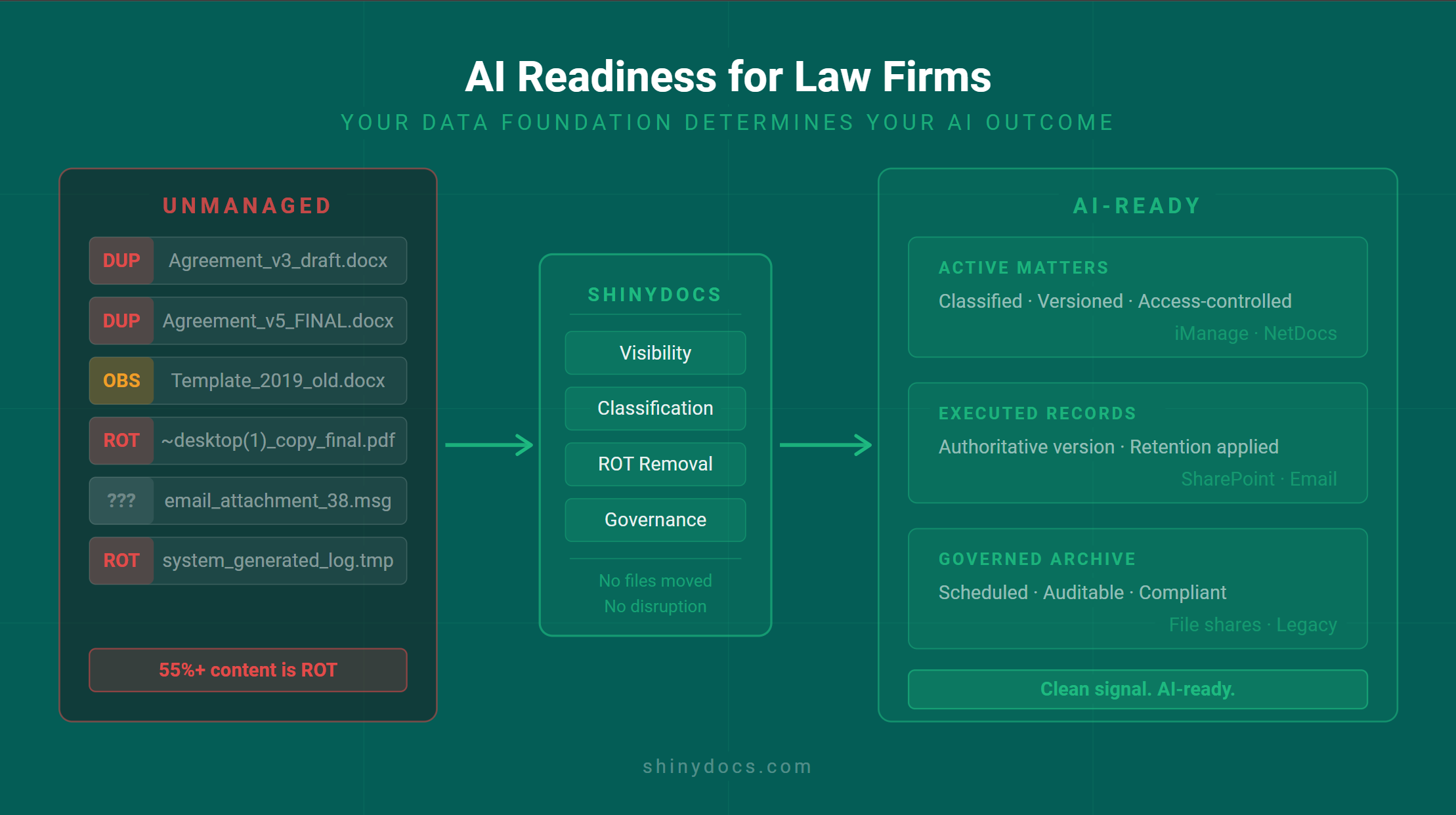 That’s the reality many firms discover after investing in new tools. The demos look great - but once deployed, results fall short. Why? Because AI data readiness for law firms is often overlooked.
Before you implement anything, you need a clear plan for preparing legal data for AI. This checklist will help you assess your firm’s current state and take the right first steps.

What Is AI Readiness for Law Firms?
AI readiness refers to how prepared your data, systems, and governance structures are to support AI tools effectively. AI systems rely on retrieving and interpreting existing data. If your content is outdated, duplicated, or unstructured, your results will be too.
That’s why how your law firm prepares for AI must start with data — not technology.
Why Data Readiness Matters Before AI Implementation
Many firms jump straight into tools and worry about cleanup later. But how to implement AI in a law firm successfully depends on what happens before deployment.
POOR DATA QUALITY IN PRACTICE |
|
☐ 55%+ of legal content is redundant, obsolete, or trivial (ROT) |
|
☐ Up to 6 duplicate versions of the same document exist |
|
☐ Sensitive data (PII) is scattered and unclassified |
|
☐ Thousands of irrelevant files inflate AI results |
This creates serious downstream challenges: lower accuracy in AI outputs, increased compliance risk, higher storage and processing costs, and reduced trust in AI systems across the firm.
The AI Data Readiness Checklist for Legal Teams
Use this checklist to evaluate your firm’s current state — and identify where the gaps are before your next AI initiative.
1. VISIBILITY: UNDERSTAND YOUR CONTENT ESTATE |
|
☐ Inventory all content across iManage, NetDocuments, SharePoint, email, and file shares |
|
☐ Analyze storage volumes and file types |
|
☐ Identify duplicate content at scale |
| ☐ Locate sensitive data and PII hotspots |
| “Do we need to clean data before using AI in law firms?” The answer is yes — and visibility is where it starts." |
2. CLASSIFICATION: STRUCTURE YOUR DATA FOR AI |
|
☐ Apply consistent metadata — document type, matter, date, version, retention class |
|
☐ Distinguish final documents from drafts |
|
☐ Ensure access controls align with classification |
This is a core part of AI governance for law firms. Without structured data, confidentiality and compliance break down — and your AI surfaces content users were never supposed to see.
3. ROT REMOVAL: IMPROVE SIGNAL-TO-NOISE RATIO |
|
☐ Eliminate duplicate files |
|
☐ Remove obsolete or superseded documents |
|
☐ Delete trivial files and system artifacts |
AI doesn’t choose the “best” version — it retrieves everything. This is the step that drives the biggest performance gains.
4. GOVERNANCE: BUILD A SUSTAINABLE AI FOUNDATION |
|
☐ Enforce retention policies within systems — not just on paper |
|
☐ Automate continuous classification for new content |
|
☐ Document and audit all disposition decisions |
Strong AI strategy for law firms always includes governance. Without it, data quality quickly degrades again — and your next AI initiative inherits the same problems as the last.
Benefits of AI in Law Firms — When Data Is Ready
When your data is properly prepared, the benefits of AI in law firms become clear:
|
Without Data Readiness |
With Data Readiness |
|
AI returns all 6 versions of a document |
AI returns the current, authoritative version |
|
Model trained on drafts, duplicates, obsolete content |
Model trained on active, high-quality records |
|
Confidentiality walls can’t be enforced |
Access restricted by matter and user role |
|
Everything retained indefinitely |
Flagged and disposed on schedule |
|
eDiscovery searches everything, no scope control |
Searches precisely within defined parameters |
These outcomes depend entirely on readiness. The tool is not the problem. The content estate is.
The Risks of Using AI Without Preparation
Skipping data readiness introduces significant risks that will surface quickly once AI tools are in the hands of fee earners:
RISKS OF DEPLOYING AI ON UNMANAGED CONTENT |
|
☐ Exposure of confidential or privileged information across matters |
|
☐ AI outputs based on outdated or superseded content |
|
☐ Compliance failures and regulatory penalties |
|
☐ Reduced trust from attorneys and clients when tools underperform |
The Right Sequence for AI Success
Most firms get this backward. They choose the AI tool first and address data quality later. But AI readiness should follow this sequence - and the firms moving fastest today are not skipping steps.
|
1 |
Assess and clean your data Run a complete inventory. Identify ROT. Understand your PII exposure and version landscape. |
|
2 |
Implement governance and classification Apply metadata, enforce retention in-system, and build a continuous governance model — not a one-time cleanup. |
|
3 |
Then deploy AI tools Now your AI investment has a trustworthy corpus to operate on. Results in production will match results in the demo. |
| Shinydocs deployments consistently identify 45–55% of law firm content as ROT. Eliminating that volume before an AI rollout directly improves the signal-to-noise ratio that determines whether AI outputs are reliable enough to trust. |
Preparing Legal Data for AI: The Bottom Line
AI is only as good as the data it accesses. If your content estate is unstructured, duplicated, or outdated, your AI investment will underperform — no matter how advanced the tool.
By working through this checklist, your firm can improve AI accuracy, reduce risk, accelerate adoption, and maximize the return on every AI initiative that follows.
Is Your Law Firm Ready for AI?
Shinydocs Pro connects to iManage, NetDocuments, SharePoint, Exchange, file shares, and more - helping firms classify and clean their content in place, without moving files or disrupting active matters.
📅 Book a demo today to see how to find and action your Shadow Copies.
shinydocs.com · info@shinydocs.com