Approx. 10-min read
Your metadata framework is either powering your legal AI OR quietly breaking it.
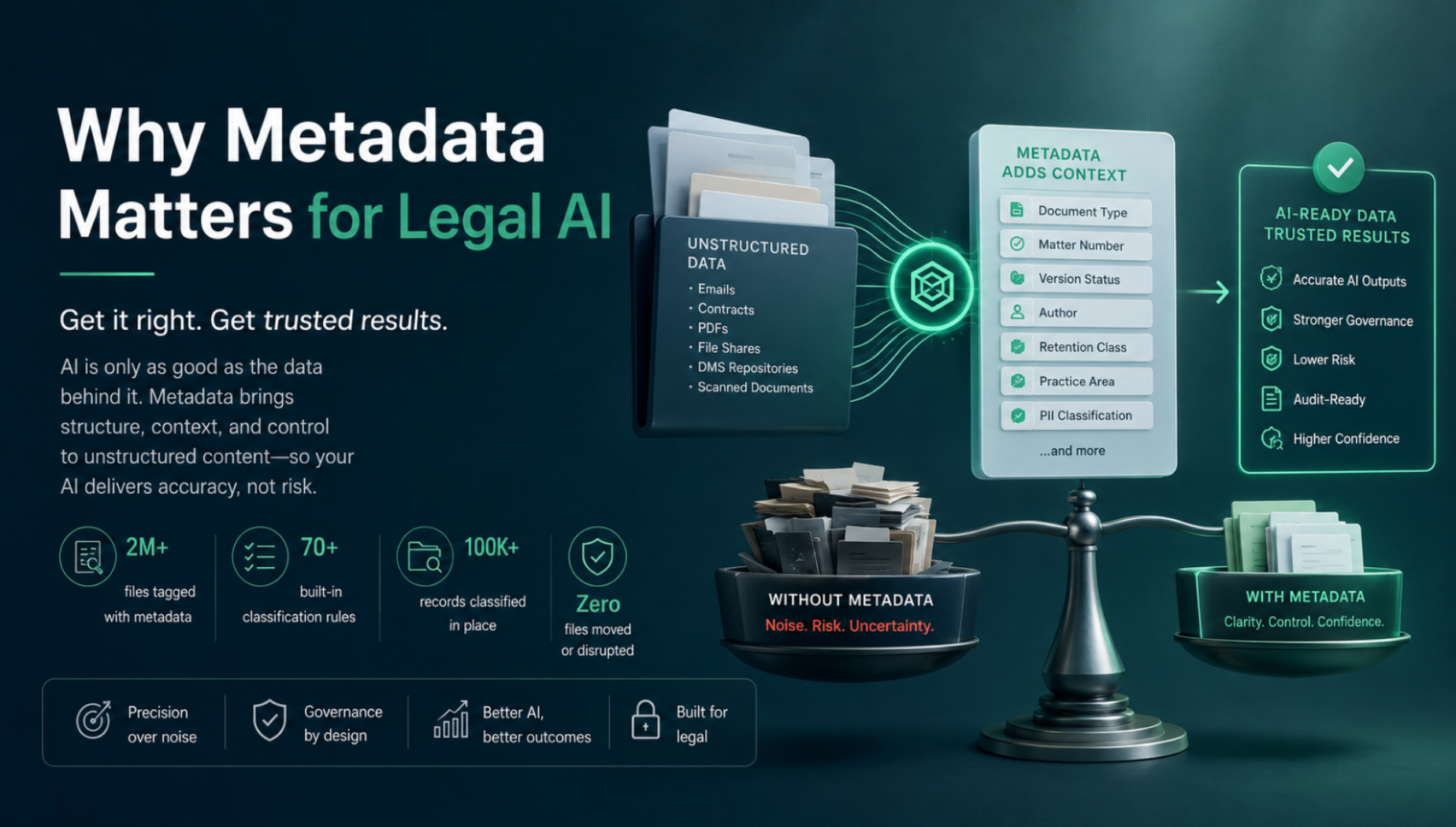
When legal AI tools underperform, most firms point at the AI model.
The real problem is the data your model has to work wit. According to IBM, as much as 68% of enterprise data is never analyzed at all.
This blog explores how your firm can improve AI accuracy, unlock value from unstructured data, and reduce legal and compliance risk through better metadata.
If your firm is investing in unstructured data discovery and AI-driven tools, metadata is the difference between precision and noise.
Why Metadata Matters at Your Firm
Strong metadata helps Legal AI deliver accurate results, stronger security, and faster document retrieval. Here are four ways strong metadata transforms Legal AI at your firm:
1. More Billable Time, Less Time Searching for Documents
Legal AI is only as effective as the data it searches. Strong metadata helps your firm organize documents across iManage, SharePoint, email archives, and file shares.
With stronger metadata, your Legal AI can:
- Surface the correct document faster during legal research and matter review.
- Identify the latest document version without manual comparison.
- Connect documents to the correct client, matter, and legal context.
- Reduce time spent searching through duplicate or outdated files.
- Partners and associates spend less time searching and more time on billable work.
For a deeper look AI-powered search and smarter information access, see our blog Why Finding Your Company’s Information Should Be as Easy as Googling Your Lunch
2. Strong Client Confidentiality and Reduced Malpractice Risk
Legal AI should never surface your confidential information to the wrong person.
With strong metadata, your Legal AI can identify who should have access to specific documents and enforces those boundaries automatically.
Strong metadata helps your Legal AI protect confidential information by:
- Content is restricted by matter and role before it can surface in a search result or AI output
- The right people see the right documents every time
3. Faster eDiscovery, Audit Readiness, and Matter Mobility
Strong metadata improves eDiscovery and audit readiness by reducing the impact of information sprawl across systems and repositories. Specifically, strong metadata enables:
- Giving your firm immediate access to accurate information during litigation, audits, and regulatory reviews.
- Surfacing exactly what is relevant instead of forcing broad and time-consuming searches.
- Helping your firm respond to regulators and opposing counsel faster with accurate audit trails.
To learn more about faster discovery, reduced information sprawl, and improved AI readiness, see our blog Streamline Your Content Strategy to Eliminate Info Sprawl & Power AI.
4. Automated Compliance Across GDPR, PIPEDA, and CCPA Requirements
Legal and regulatory obligations continue to grow across jurisdictions.
With strong metadata, your Legal AI can:
- Identify Personally Identifiable Information (PII)
- Enforce access controls
- Apply retention policies automatically across every repository

What Is Metadata?
Metadata is the label on your file or document which describes your content. When you capture an image on your phone, that image is the data. But your phone also automatically quietly records the:
- Time
- Date
- Location
- File Size
That's metadata.
Now scale that to a law firm with hundreds of thousands of documents across:
- iManage
- Sharepoint
- Email archives
- File Shares
All of these files contain metadata that helps your system describe, find, govern and secure your content.
Without metadata, your AI tools cannot distinguish:
1. An executed agreement from a third-round markup
2. A privileged communication from general correspondence
3. A final contract version from an outdated draft
4. Matter-related documents from unrelated client files
5. A record under retention from one that should have been deleted
In a legal environment, your metadata would include the details below. These fields tell your systems what the file or document is and what to do with it.
Types of Metadata
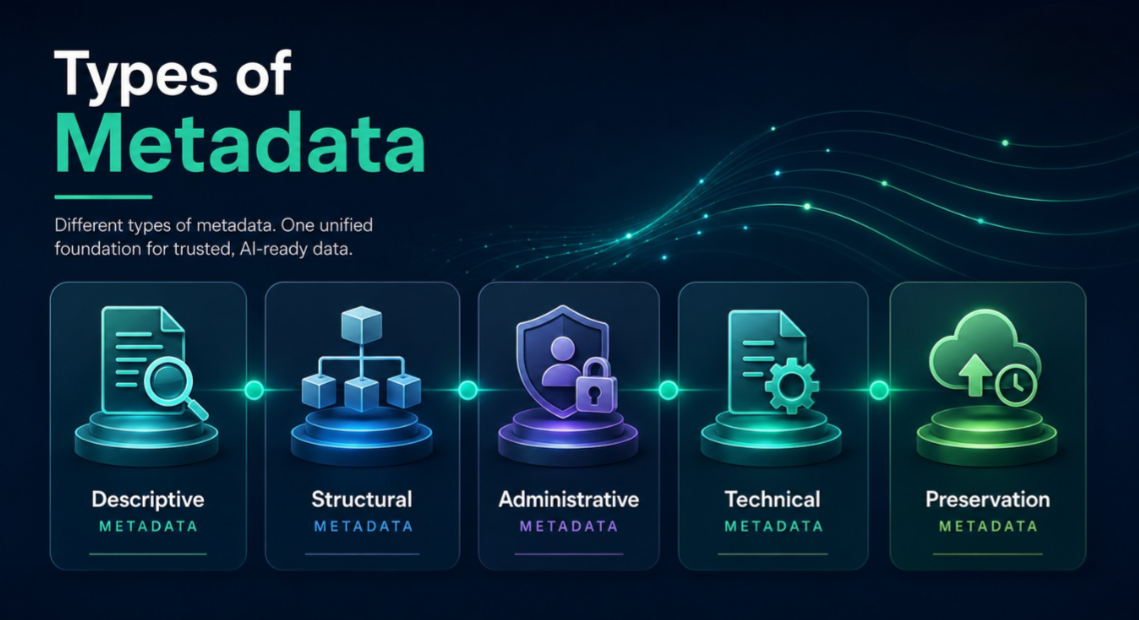
The first step to building a functioning metadata framework is to understand the different types of metadata.
Descriptive Metadata
Descriptive metadata makes your search results accurate. It identifies the type of document a file is using the information below:
Structural Metadata
Think of structural metadata as the table of contents for your firm's information. It helps legal AI understand how documents connect across matters, versions, and case files. Structural metadata also serves the following purposes:
- Defines how documents relate to one another.
- Shows which version supersedes another
- Highlights which files belong to the same matter
- Outlines how a case file is organized.
Administrative Metadata
Administrative data covers ownership, access permissions, and retention policies. It records the document creator, who can modify it, and how long to keep it.
This type of metadata:
- Makes governance
- Helps legal AI enforce confidentiality It helps legal AI enforce confidentiality boundaries, ethical walls.
- Maintains matter-level access controls.
Technical Metadata
Technical Metadata makes sure the systems store, process, and display content correctly across platforms. It describes the files itself, including its:
- Format
- Size
- Encoding
- Storage location
Preservation Metadata
Ensures there is long-term document and file usability. This metadata tracks:
- Backup history
- Format migration
- Strategies for keeping data accessible
According to IBM very few firms have consistent metadata, governance, and classification standards across every repository. That gap is where AI starts to fail.
The Role of Metadata in Data Management
In a law firm, documents don't sit still, they move through a lifecycle. At each stage, metadata is either working for you or creating problems you'll deal with later.
Here is how it works in practice:
1. Metadata at Creation:
Your data management system captures metadata at the start including:
- Document type
- Author
- Matter number
- Date
- Keywords
- Classification tags
2. Metadata at Storage:
Metadata gives your team the structure needed to organize content logically and consistently. It supports: version control, tracks modifications, and ensures files don't pile up without context.
3. Metadata at Retrieval:
Metadata allows you to search faster and more accurately, instead of searching through thousands of files. Your systems use metadata to find exactly what you need.
4. Metadata at Archiving:
Retention and Disposition metadata ensure that your content stays usable and compliant long after you use it. Retention and disposition metadata help systems enforce policies automatically and maintain long-term compliance.
If metadata is not anchored at each of these stages, data will accumulate indefinitely, risk compounds and AI will have no foundation to work from.
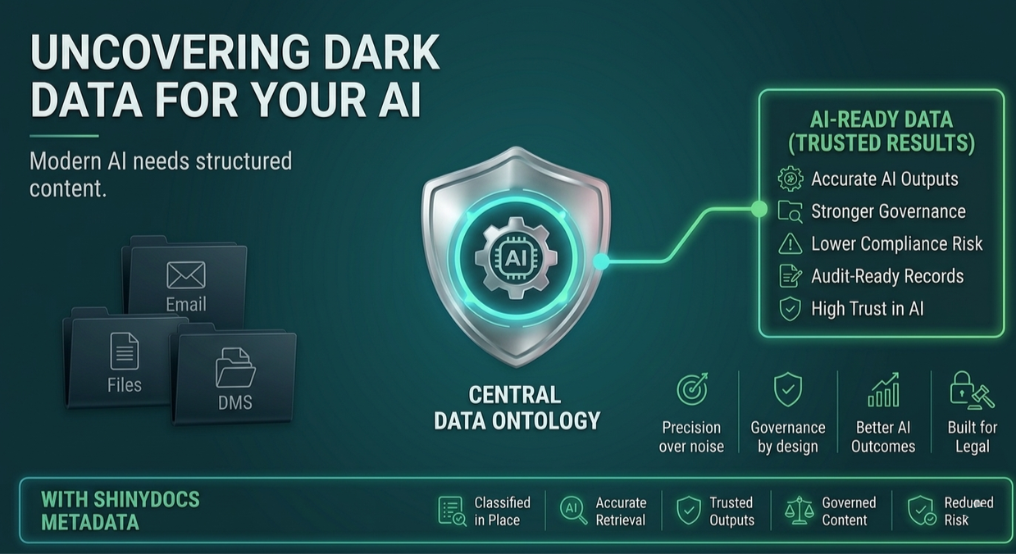
Hidden Data in Legal Documents: The Dark Data Problem
Dark data is the metadata management problem. Most firms don't know how much dark data exists in their environment.
Your systems store dark data content that:
- Has unknown value
- Lacks classification
- Low access frequency
Your AI systems don't ignore dark data, they ingest it. This turns:
- Noise into outputs
- Risk into results
- Unnecessary cost into processing
According to a 2025 IBM report, more than a quarter of organizations estimate that they loose at least USD $5 million each year.
Shinydocs helps you surface this content automatically, classifying it in place without moving a single file.
You can see exactly what is sitting unclassified across your environment and take action immediately.
What Good Metadata Enables for Your Law Firm
Metadata doesn't need to be perfect, it needs to be consistent.
These cases below show how the metadata consistency separates AI that sounds good from AI that actually works.
| Cases | Without Metadata | With Metadata |
| AI Search | Returns all versions | Returns the authoritative version |
| Model Training | Learns from duplicates and outdated content | Learns from high-quality, current records |
| Access Control | Cannot enforce confidentiality | Restricts by matter and role |
| Retention | Retains everything indefinitely | Enforces defensible disposition |
| eDiscovery | Broad, inefficient searches | Precise, scoped results |
| PII Protection | Can't identify sensitive content | Flags and governs PII automatically |
Three Metadata Failures That Break Legal AI
Most legal AI failures in your environment come down to one of these three metadata problems:
1. No Version Metadata:
Most legal repositories contain duplicates versions of a document.AI treats drafts and final versions identically causing it to provide incorrect answers based on the wrong information.
Lawyers are understandably cautious about AI hallucinations. According to IBM, without strong metadata, AI systems cannot reliably distinguish authoritative records from outdated or irrelevant content.
2. No Access Classification:
Legal work relies on confidentiality boundaries between clients, matters, and teams. Access classification encodes those boundaries into your systems. Without it, your AI has no way to distinguish between what’s privileged, what's restricted, and who should see what. Your firm risks cross-matter exposure, compliance framework break downs, and privileged content surfacing in the wrong hands. This isn’t because the AI failed, but because it was never told the rules.
To learn more about automated classification and governance, see our blog What Is Automated Content Identification?
3. Inconsistent Classification Across Systems:
If one person labels a document "Final", and another calls it "Executed", your AI is working with different answers to the same question. It can't reliably filter, find, or act on content that isn’t consistently named. Here, information lifecycle management platforms earn their value by enforcing classification standards across every system, not just inside one.
Choosing Software for Unstructured Data Compliance and Retention
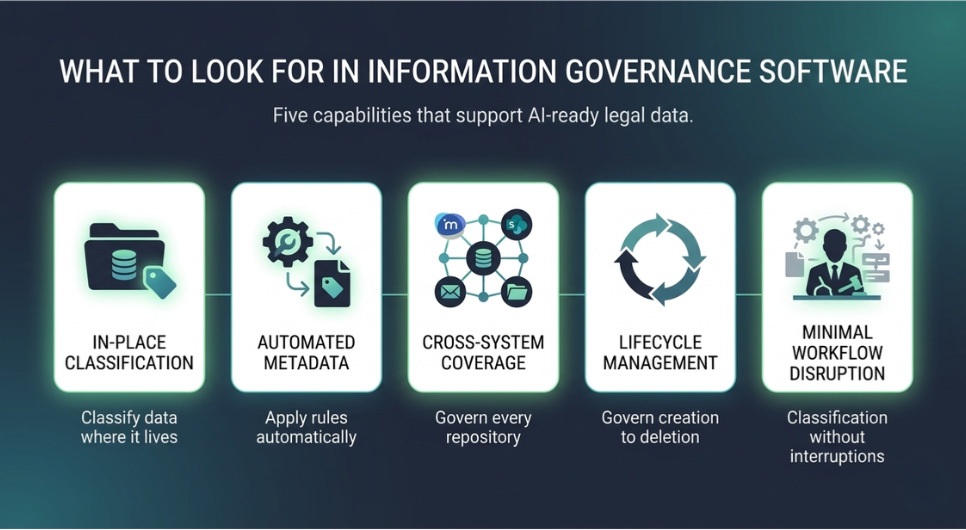
Not all information governance tools solve the same problem. When reviewing software for unstructured data compliance and retention, your firm should prioritize the following:
1. In-Place Classification
In-place classification is the process of tagging and organizing data where it already lives, without moving it to a new system. It adds structure and metadata directly to existing files so they can be searched, governed, and used more effectively.
Shinydocs classifies data in place from the first crawl, applying structure and metadata directly within the systems you already use without requiring data migration.
2. Automated Metadata Application
Automated metadata application is the process of automatically adding tags to data using rules instead of manual input. It ensures content is consistently labelled as it’s created, making it easier to find, manage, and govern.
Manual tagging doesn't scale. Shinydocs uses 70+ built-in classification rules and can be customized to match any classification scheme your firm uses.
3. Cross-System Coverage
Cross-systems coverage means applying consistent metadata and classification across all your systems and repositories, not just one platform. It ensures that data is searchable, governed, and usable no matter where it lives.
Your data doesn't live in one place, it's spread across iManage, SharePoint, email archives, and file shares. Shinydocs connects to every repository your firm uses and applies consistent standards across all of them.
4. Legal Information Lifecycle Management Capabilities
Information lifecycle management gives you the ability to manage data from creation through retention and deletion in a controlled, structured way. It ensures information is properly governed, retained, and disposed of based on its value, risk, and compliance requirements.
Document classification is only the beginning. Look for tools that govern content from creation through defensible deletion, not just point-in-time cleanup.
5. Minimal Disruption to Legal Workflows
Minimal disruption to legal workflows means implementing data management tools in a way that doesn’t slow down or interrupt how legal teams work. The goal is to improve structure and compliance in the background without changing day-to-day processes.
If lawyers have to change how they work, AI adoption will likely suffer. Shinydocs runs silently across your environment and your team keeps working while classification happens automatically.
Strong Metadata Transforms Records Management for AI-Driven Firms
Records management was always viewed as a compliance function. Now, with the right metadata foundation, it's become an invaluable competitive advantage.
Strong records management gives your firm the following strengths in an AI driven environment:
Higher-quality AI outputs:
Your metadata model uses accurate and current records, not duplicate and outdated content.
Reduced legal and regulatory risk:
PII is identified, access is controlled and retention policies can be enforced.
Lower storage and infrastructure costs.
Information lifecycle management removes data you no longer need to keep.
Faster internal buy-in:
Document classification makes search results more accurate and targeted.
Increased trust in firm-wide systems:
When lawyers trust the results, AI adoption becomes easier.
The Core Insight: Metadata is the Infrastructure for Legal AI
Your AI is only as good as the metadata behind it.
Without it, your firm risks:
- Inconsistent outputs
- Increased risk
- Stalled AI adoption
With it, your firm receives:
- Precise outputs
- Enforceable Information Governance
- Measurable Investment Value
This difference shows clearly how reliably AI can surface the right information at the right time. Over time, that reliability shapes how much trust teams place in the system and how widely it gets adopted across the firm.
Firms with strong metadata aren't just reducing risk. They're building a competitive advantage.
Close Metadata Gaps Before They Undermine Your Legal AI
Every failure mode covered in this piece, dark data, inconsistent classification, missing access controls, comes back to the same root cause: metadata that wasn't built to support AI. Fixing that foundation doesn't require a migration or a disruption to how your team works. It requires the right tool applied consistently across every repository your firm uses. That's what Shinydocs does from the first crawl.
Shinydocs automatically applies metadata across every connected repository using 70+ built-in classification rules from the first crawl, without manual file review, data movement, or disruption to active matters.
See what Shinydocs finds in your content estate.
📅 Book a demo call today to request a Metadata Assessment.
Topics: AI, Dark Data, GDPR, Risk Management, Information Governance, Data Governance, Unstructured Data, Data Insights, Data Management, Data Strategy, data enrichment AI, AI document tagging, Shadow Copies
shinydocs.com · info@shinydocs.com