Key Takeaways
- Matter transitions expose weak information lifecycle management, forcing firms to locate, classify, and govern content under tight deadlines.
- ABA Formal Opinion 489 requires orderly client transitions, achievable only when firms keep information organized and retrievable.
- Fragmented repositories, accumulated redundant, obsolete, and trivial (ROT) content, and weak classification make matter transitions costly and error-prone.
- Manual transitions drain information governance (IG) and IT resources, inflate eDiscovery costs, and expose firms to malpractice claims.
- Automated federated search, classification, and defensible disposition turn matter mobility from reactive cleanup into controlled, auditable execution.
Matter transitions aren’t just an operational challenge. They’re a test of how agile your firm's information governance practices are.
Information lifecycle management (ILM) plays a critical role in matter mobility and transitions, ensuring legal content is retained, governed, and disposed of appropriately. Yet when key staff or partners announces their departure, firms are often left scrambling, and ILM programs are put to the test fast.
Suddenly, it feels impossible to find all the files you need to transfer, keep, and dispose. Here, we explore the information lifecycle management gaps that complicate matter transitions, risks they create, and how automated lifecycle management can help
Matter Transitions and Information Lifecycle Management
Matter transitions often expose gaps in your information lifecycle management. They require firms to quickly understand where matter-related information exists across their environment.
Lawyer departures and lateral hires are regular events for many firms. They're also not the only events that can trigger matter mobility.
Client transitions, matter closures, mergers, divestitures, and other information governance events can also require firms to review and transfer information.
AmLaw 200 recorded 3,009 lateral partner hires in 2025 alone. This marks a five-year high, up 10% from the prior year.
These events can require teams to:
-
Identify the matters and information involved
- Review content across relevant systems
- Determine what is eligible for transfer, retention, or disposition
- Document decisions throughout the process
Matter Transition Obligations for Law Firms
ABA Formal Opinion 489 requires your firm to ensure an orderly transition of client matters when a lawyer departs. That process requires firms to maintain appropriate control over client information throughout the transition, which includes:
1. Protecting Confidential Client Information
Client confidentiality doesn't pause during a transition. Matter content must remain appropriately controlled as files are located, reviewed, and transferred.
2. Notifying Clients and Enabling File Transfer
Legal professionals must inform clients and make eligible files available without unnecessary delays. Firms must first identify and evaluate client-related information before determining what should be transferred.
Transfer decisions may depend on firm policy, client direction, engagement terms, legal holds, and jurisdictional requirements.
3. Govern Content Disposition
Firms need clear policies for what happens when a matter closes or a lawyer leaves, what transfers, what is retained, and when destruction is appropriate.
Automation can accelerate identification and collection. However, firm personnel remain responsible for reviewing content and making final transfer, retention, and disposition decisions.
4. Maintain Service Continuity
Firms must ensure clients continue to receive competent and diligent representation during lawyer departures and data migration activities. The representation must not disrupt any active matters.
5. Keep Clients Informed
Firms must notify clients of a lawyers departure and any changes that may affect their matter. Clients must have enough information to make decisions about their representation.
6. Establish Firm-Wide Compliance Systems
Responsibility sits with firm leadership to ensure the right systems, processes, and oversight are in place to meet all obligations.

The Cost of Weak Information Lifecycle Management in Matter Transitions
When a matter transition goes smoothly, it rarely gets noticed. But if your firm misses something such as a document, an email, or a deadline, the consequences can be significant, including:
- Teams spend hours searching for information
- Clients become frustrated
- The firm faces unnecessary risk
These failures are often symptoms of the same underlying problem. Firms don't have a clear view of where information lives or how it should be managed when a lawyer leaves. Without consistent governance from creation through disposition, your costs of manual matter transitions are significantly amplified.
The Hidden Costs of Manual Matter Transitions
|
Cost Category |
What it looks like in practice |
|
Information Governance (IG) and IT staff time |
|
|
Expanded eDiscovery scope |
|
|
Bar complaints and disciplinary proceedings |
|
|
Malpractice exposure |
|
|
Client relationship damage |
|
|
IT Reliance |
|
|
Merger Complexity |
|
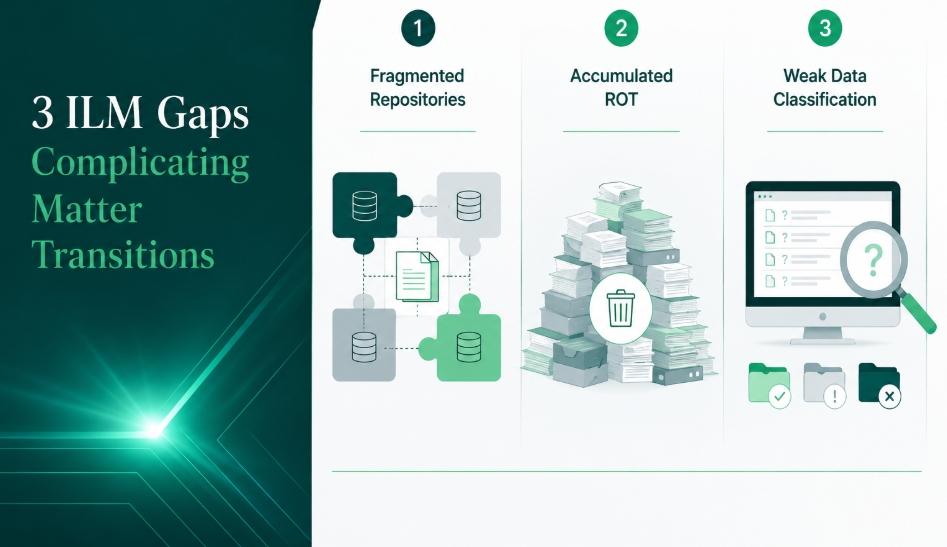
3 ILM Gaps Complicating Matter Transitions
Matter transitions expose every weakness in your firm's information governance and records management framework. At the core of these weaknesses is often inconsistent information lifecycle management. This prevents you from maintaining a complete, accurate understanding of their information estate.
1. Fragmented Repositories
- Mergers leave your firm with a patchwork system that weren't designed to work together
- Documents may be organized differently across systems, making it harder to gather everything related to a matter
- Lawyers who have been through multiple mergers may have work scattered across several repositories
- Without visibility across all systems, your team faces a significant manual undertaking to piece together a complete matter file
2. Accumulated ROT
- Without lifecycle governance, your firm accumulate large volumes of redundant, obsolete and trivial content over time
- More data means your team has more to review, filter, and migrate, much of it no longer relevant
- The root cause is often your firms lack of systematic document destruction for content past its retention period
- Every time you delay a disposition decision, you make future transitions more expensive and more complex
3. Weak Data Classification
- Without clear classification, your teams struggle to determine what needs to move, what needs review, and what can stay
- Transitions slow down as your teams sort through content that should already have been organized
- You risk missing something important or accidentally leaving critical files behind
Manual Matter Transitions Disrupt Information Lifecycle Management
Steps in Manual Matter Transitions
Once your firm learns that a lawyer is leaving, you have little notice before the transition process begins. For many firms, manual matter transitions involve a long series of steps across different teams, including:
1. Teams identify the clients and matters involved
This may require searching the document management system and speaking with colleagues to determine what work the lawyer was responsible for.
2. Additional information is requested from IT
Emails, archived records, or information stored in older systems may not be easily accessible to records or information governance teams.
3. IT gathers the requested information
Depending on competing priorities and the systems involved, this process can take valuable time.
4. The client files are assembled for transfer
Your team assembles the client files for transfer, reviewing and organizing documents from different sources into a package they can share appropriately.
5. Physical records are handled separately
Your team handles physical records separately, locating, reviewing, and preparing paper files for transfer alongside electronic records.
6. The completed files are transferred
Information is often shared through email, file-sharing platforms, or other methods that may provide limited visibility into the overall process.
Manual Work Habits Undermining Information Lifecycle Management
Matter transition problems start before a lawyer's departure is announced. They emerge through everyday decisions your attorneys make. Under constant pressure, attorneys are expected to file every document correctly in a DMS but in practice, they include:
- Saving a working draft to their desktop instead of iManage.
- Email client files from their personal Outlook rather than filing them properly
- Keep working notes in a local folder that no governance policy has ever touched
Attorneys are under constant pressure. Filing every document correctly in a data management system (DMS) adds friction to an already demanding workload.
Over years of practice, your attorneys store a significant portion of matter-related content ends up outside the firm's system of record. This results in dark data, which increases compliance risk and breaks down manual processes.
Automated Information Lifecycle Management Streamlines Matter Transitions
A mature information governance and matter transitions framework transforms your matter mobility from reactive cleanup into controlled execution. See how automated information lifecycle management simplifies your matter transitions below.
Federated Search Provides Enterprise-Wide Visibility
A governed content estate means your IG team can search across all repositories at the same time from one place. Instead of submitting IT tickets for help, they can quickly run a search across everything linked to a departing attorney’s matters. This makes it easier to build a complete inventory of all the content, without having to find information in multiple systems.
You can search all your repositories from Shinydocs information lifecycle management solution, without migrating a single file.
Data Classification Gives Better Control at Scale
The IG team can make better transfer decisions at scale when content is classified and they know what they have and where it lives. Teams get the ability to:
- See content tagged by file type, matter status, document type, privilege designation, and retention class.
- Filter out content that is clearly not in scope, and flag content that requires privilege review.
- Identify files that carry confidentiality obligations before anything moves.
- Enforce retention schedules and document destruction when content has reached an end of life.
- What was identified, transferred or excluded
- Who approved actions
- When decisions were made
Shinydocs uses high-confidence AI to flag PII and sensitive content across every connected system. ROT and duplicates are identified simultaneously.
Clean Data with Deduplication and ROT Reduction
A content estate that has undergone systematic ROT reduction is cheaper to operate when a departure occurs. The ROT data that inflate search results, expand eDiscovery scope, and complicate review decisions have already been disposed of. Fewer files means lower processing costs, faster review, and a smaller notification population if the event involves a breach.
Shinydocs identifies ROT and duplicates simultaneously across every connected system, reducing infrastructure, backup, and discovery costs by up to $24K per 10TB.
Auditable Matter Transition Trails for Simplified Compliance
Create a defensible audit trail for every matter transition. Every action during matter transitions is logged.
Shinydocs uses 70+ built-in rules for accurate decisions.
Governance Execution with Automated Retention Schedules
Helps to enforce retention schedules, making them part of your workflow rather than an ideal on paper.
With Shinydocs, your form can apply defensible disposition rules to trigger destruction without manual intervention.

How Shinydocs Supports Information Lifecycle Management in Matter Transitions
Shinydocs enables firms to operationalize information lifecycle management and matter transitions at scale. Firms can view matter-related information across iManage, NetDocuments, Exchange, and legacy repositories without moving the underlying files.
These capabilities work together to reduce the time, risk, and manual effort involved in preparing matter transitions.
How Shinydocs Information Lifecycle Management Solution Works
1. Inventory and Federated Search
Every repository scanned, tagged, and scored. You can search for files across repositories from one place without migration.2. PII and Privilege Classification
You get high-confidence flags on PII and sensitive content across every connected system. ROT and duplicates surface at the same time, so you're never chasing them separately.
3. Human Review Where It Counts
Ambiguous content lands in front of a reviewer with full context. Your team spends time only on decisions that actually need a human.
4. Defensible Disposition of ROT
Redundant, obsolete, and trivial content gets disposed of, and you keep a full audit trail. Your storage costs drop, and governance rules stop the pile from coming back.
5. Retention Schedule Enforcement
Every classified record gets your retention schedule applied automatically. What you wrote in your policy becomes what actually happens to your data.
Build a Solid Information Lifecycle Management Program
Matter transitions expose the weakest points in an organization’s information lifecycle management. When you don’t know where your content lives, applying retention schedules and disposing of it becomes nearly impossible.
A solid automated ILM solution ensures information is properly governed, from creation through closure, reducing exposure and improving continuity across teams. Shinydocs information lifecycle management solution ensures every file is governed properly, without the manual hassle.
Is your content estate ready for a partner departure?
📅 Book a demo call today and see what's living in your content estate and what it takes to get transition-ready.
Topics: Information Governance, Enterprise Search, Information Lifecycle Management, Records Management, Legal
shinydocs.com · info@shinydocs.com